

Who Is at Fault in a California Left-Turn Accident?
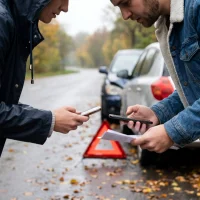
Left-turn accidents can cause serious injuries when a vehicle crosses the path of oncoming traffic. These collisions often happen at intersections when a driver misjudges another vehicle’s speed, fails to yield, or attempts to turn before the road is clear. Determining who is responsible is not always straightforward, particularly when drivers offer conflicting accounts of what happened. The California car accident lawyers at Kalfayan Merjanian, LLP represent people injured in serious motor vehicle accidents; our team understands how evidence and California traffic laws can affect the outcome of a claim.
Although drivers making left turns often have a duty to yield, the turning driver is not automatically responsible for every collision. Traffic signals, the conduct of oncoming drivers, witness statements, and physical evidence can all help establish fault.
What Are California’s Right-of-Way Rules for Left Turns?
California Vehicle Code Section 21801 requires a driver intending to turn left or make a U-turn to yield to approaching traffic that is close enough to present an immediate hazard. The driver must wait until the turn can be completed with reasonable safety.
This rule applies when a driver turns left at an intersection or into a driveway or other location where the turn crosses oncoming traffic. A driver who turns directly in front of an approaching vehicle without sufficient space may be found negligent if the maneuver causes a crash.
That said, having the right of way does not give a driver permission to ignore road conditions or drive carelessly. A driver traveling straight may still be responsible if speeding, distracted driving, or another unsafe action contributed to the collision.
Investigators must evaluate the circumstances surrounding the turn, including vehicle speeds, distances, visibility, and whether either driver had a reasonable opportunity to avoid the crash.
How Do Traffic Signals Affect Fault in a Left-Turn Accident?
Traffic signals can play a major role in determining responsibility. A driver making a left turn on a circular green light generally must yield to oncoming traffic unless that traffic is stopped or otherwise does not pose an immediate hazard. The green light permits the driver to proceed when it is safe; it does not automatically grant the right of way.
A green arrow providing a protected left turn generally gives the turning driver the right of way over conflicting traffic. If another driver runs a red light and strikes a vehicle lawfully turning under a protected arrow, the driver who disregarded the signal may bear responsibility.
Some collisions occur when a driver enters an intersection as a light changes. Investigators may need to determine which driver entered against a red signal, whether a vehicle was already lawfully in the intersection, and whether either driver had time to react.
Traffic camera footage, nearby business surveillance, witness accounts, and vehicle data may help establish the sequence of events. Signal timing information may also be relevant when the circumstances warrant further investigation.
Can an Oncoming Driver Be at Fault for a Left-Turn Collision?
Yes. Although drivers turning left have a duty to yield, an oncoming driver may share responsibility or bear primary responsibility in certain circumstances. For example, a driver traveling well above the speed limit may make it difficult for another driver to judge the time available to complete a turn. A driver who runs a red light, drives while distracted, or fails to take reasonable steps to avoid a collision may also contribute to the crash.
The turning driver’s obligation to yield does not excuse another driver’s negligence. The question is whether each driver’s conduct contributed to the collision and resulting injuries.
In some cases, both drivers may have acted carelessly. A driver may have turned when there was insufficient space, while the oncoming driver was speeding. California law allows responsibility to be divided according to each party’s share of fault.
How Can You Determine Who Caused the Accident?
When drivers disagree about a left-turn accident, evidence can be critical. Each driver may claim to have had the right of way, and insurance companies may reach different conclusions about responsibility.
Police reports can provide an initial account of the collision, including statements from drivers and witnesses, observations made at the scene, and any traffic citations. However, a police report does not necessarily resolve every disputed issue of fault.
Other important evidence may include:
- Photographs of vehicle damage, skid marks, road conditions, and the intersection.
- Surveillance footage or traffic camera recordings showing the vehicles before impact.
- Statements from independent witnesses who observed the collision.
- Vehicle event data recorder information, when available, that may provide details about speed, braking, or other vehicle activity.
- Accident reconstruction analysis evaluating vehicle movements, impact locations, and whether either driver had time to avoid the crash.
Medical records can also help document the injuries caused by the collision, although they do not usually establish which driver was at fault.
Evidence should be preserved as soon as reasonably possible. Surveillance footage may be erased, witnesses may become difficult to locate, and physical evidence can disappear as vehicles are repaired or road conditions change.
What Happens When Both Drivers Share Responsibility?
California follows a system called comparative negligence. Under this rule, an injured person may recover damages even if they were partly responsible for an accident, although their compensation can be reduced according to their share of fault.
For example, suppose a driver making a left turn is found 70% responsible for a collision, while the oncoming driver is found 30% responsible because of speeding. If the oncoming driver has $100,000 in recoverable damages, their award would be reduced to $70,000 to reflect their 30% share of responsibility.
The actual allocation depends on the evidence and the circumstances of the collision. A driver’s initial account or an insurance company’s preliminary decision does not necessarily establish the final division of fault.
When the parties disagree, evidence about speed, traffic signals, visibility, and the timing of the turn can help determine how responsibility should be allocated.
How Can a Left-Turn Accident Affect an Injury Claim?
The driver found responsible for a left-turn accident may be liable for injury-related losses, subject to applicable law and any allocation of fault. These damages may include medical expenses, lost income, reduced future earning capacity, pain, and other effects of the injuries.
Insurance companies often investigate how the collision occurred before deciding whether to accept a claim or offer a settlement. If the evidence is disputed, an insurer may argue that the injured person contributed to the accident or that the injuries are less serious than claimed.
An injured person should preserve available evidence, seek appropriate medical care, and be cautious about providing recorded statements or accepting a settlement before understanding the extent of the injuries and the available coverage.
When a collision causes serious injuries, a thorough investigation may be necessary to establish liability and document the full extent of the resulting losses.
Get Help After a Serious Left-Turn Accident in California
Determining fault in a California left-turn accident requires more than identifying which vehicle was turning. Right-of-way rules, traffic signals, driver behavior, witness statements, and physical evidence may all affect the outcome. Even when a turning driver appears responsible, another driver’s negligence may contribute to the collision.
Kalfayan Merjanian, LLP represents people who have suffered serious injuries because of negligent drivers. As California trial attorneys, the firm understands the importance of investigating disputed collisions and building evidence-supported claims. If you or a loved one has been injured in a left-turn accident, contact Kalfayan Merjanian, LLP to discuss your situation and learn how the firm may help you pursue compensation.
