
Common Causes of Multi-Vehicle Chain-Reaction Collisions
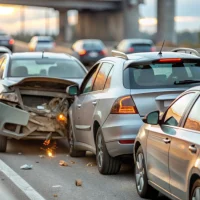
Multi-vehicle chain-reaction collisions can happen in just seconds. One driver may fail to stop in time, striking another vehicle and pushing it into traffic ahead. A rear-end crash can then become a series of collisions involving several vehicles, multiple drivers, and potentially serious injuries.
Determining who is legally responsible can be much more complicated than identifying the vehicle that made the first impact. In a chain-reaction collision, several drivers may have contributed to the sequence of events, and another party, such as a trucking company, vehicle manufacturer, or government entity responsible for roadway conditions, may also potentially bear responsibility. At Kalfayan Merjanian, LLP, our California car accident injury lawyers understand the importance of carefully investigating these crashes to determine how they occurred, who contributed to them, and what compensation an injured person may be entitled to recover.
What Causes Multi-Vehicle Chain-Reaction Collisions?
Chain-reaction collisions frequently begin with a relatively common driving mistake or hazardous circumstance. Once the first collision occurs, however, the vehicles and drivers involved may have very little time to react.
Common contributing factors can include:
- Following too closely or failing to maintain a safe stopping distance
- Distracted driving, including cellphone use
- Excessive speed or driving too fast for traffic conditions
- Sudden lane changes or unsafe merges
- Driver fatigue or impairment
- Aggressive or reckless driving
- Poor visibility caused by fog, rain, smoke, or darkness
- Unexpected traffic congestion or a sudden stop
- Mechanical or equipment failures
- Hazardous roadway conditions
In some situations, the initial crash may not be caused by the driver who ultimately causes the greatest amount of damage. For example, a driver may stop suddenly because of a roadway hazard, another driver may react too slowly, and a third vehicle may then collide with the vehicles in front of it. Each event in the sequence may need to be examined separately.
Why Is It Difficult to Determine Who Is Liable?
The physical damage in a chain-reaction collision can make the sequence of events difficult to reconstruct. Vehicles may be struck multiple times, and witnesses may remember only portions of what happened. Drivers involved in the crash may also have conflicting accounts of which vehicle hit which vehicle first.
There is often an important distinction between causing a collision and being legally responsible for a particular injury. A driver might have contributed to the first impact but have little or no responsibility for injuries caused by a later collision. Conversely, a driver who struck another vehicle from behind may argue that the collision was unavoidable because another motorist created the initial emergency.
For that reason, an investigation may need to establish the timing and location of each impact, the speed and direction of the vehicles, the spacing between vehicles, traffic and weather conditions, and whether each driver had a reasonable opportunity to avoid the collision.
What Evidence Can Help Establish Fault in a Chain-Reaction Crash?
Physical evidence can be particularly important when the drivers provide conflicting accounts. Investigators may examine vehicle damage, skid marks, debris fields, roadway conditions, vehicle data, photographs, surveillance footage, and available dash-camera recordings.
Witness statements can also provide information about what happened immediately before the first impact and how the subsequent collisions unfolded. Police reports may identify preliminary accounts and observations, but they are not necessarily the final word on civil liability.
In more complicated cases, accident reconstruction professionals may analyze the available evidence and develop opinions concerning vehicle speeds, collision points, reaction times, and the sequence of impacts. The objective is to reconstruct what actually happened rather than simply accepting one driver’s version of events.
Can More Than One Driver Be Responsible for a Chain-Reaction Collision?
A multi-vehicle accident can involve multiple negligent parties whose conduct contributed to the same injury. Consider a situation in which a distracted driver rear-ends a vehicle stopped in traffic. The impact pushes that vehicle into another motorist, who then collides with a fourth vehicle. Depending on the evidence, more than one driver could potentially be found negligent. Another example could involve a commercial truck traveling too quickly for congested conditions. The truck may collide with another vehicle after the driver ahead stops suddenly. If the evidence establishes that another driver was also following too closely, responsibility may potentially be allocated among multiple parties rather than assigned entirely to one person.
The investigation therefore needs to look beyond the first impact. A driver who appears to be the obvious cause of the crash may not be the only party whose conduct legally contributed to the resulting injuries.
Can a Company or Other Non-Driver Be Liable?
Sometimes a chain-reaction collision involves parties other than individual motorists. A commercial vehicle may raise questions about the conduct of the driver and the driver’s employer, including whether the driver was acting within the scope of employment. There may also be issues involving negligent hiring or supervision, vehicle maintenance, or inadequate training, depending on the facts.
A defective vehicle component such as faulty brakes or steering could create another potential source of liability. Similarly, dangerous roadway conditions or inadequate traffic-control measures may raise questions about the responsibility of a governmental entity or another party involved in the roadway’s design, construction, or maintenance.
These possibilities make a comprehensive investigation particularly important. The appropriate defendants cannot always be identified simply by looking at the vehicles involved in the collision.
How Does California’s Comparative Fault System Affect a Multi-Vehicle Case?
California generally uses comparative fault principles when determining responsibility among parties who contributed to an injury. A jury may be asked to determine the percentage of fault attributable to each responsible person or entity, as well as any percentage attributable to the injured plaintiff.
This can become particularly important in a chain-reaction collision because the defense may attempt to shift responsibility among the drivers involved. A defendant may argue that another driver caused the emergency, that a later driver failed to react appropriately, or that the injured person was partially responsible for the resulting harm.
Comparative fault can involve defendants, the plaintiff, and other nonparties whose conduct contributed to the injury. Determining the percentage of fault is therefore a critical part of the litigation. An injured person should not assume that being assessed some portion of the blame automatically eliminates the possibility of substantial recovery.
“Joint and Several Liability” in Multi-Vehicle Collisions and Pile-ups
California’s rules concerning multiple defendants are particularly important in cases involving significant injuries and multiple potentially responsible parties. Civil Code section 1431.2 distinguishes between economic and non-economic damages in actions based on comparative fault, including personal injury and wrongful death claims.
Economic damages consist of objectively verifiable financial losses. The statute specifically includes categories such as medical expenses, lost earnings, burial costs, costs of obtaining substitute domestic services, and certain losses involving employment or business opportunities. California retains the legal concept of joint and several liability for economic damages caused by multiple tortfeasors. This means that, subject to the applicable rules, a plaintiff may seek recovery for the full amount of economic damages from any defendant who is jointly liable, rather than being limited to that defendant’s percentage of fault. This rule helps injury victims get a fuller recovery from a negligent defendant with the means to cover the damages, even when they only shared a portion of the blame.
Non-economic damages, however, are treated differently. These damages include losses such as pain and suffering, emotional distress, and other subjective, non-monetary harm. Under Civil Code section 1431.2, when the action is based on shared fault, each defendant is liable for non-economic damages only in proportion to that defendant’s assigned percentage of the blame.
For example, suppose an injured plaintiff has $500,000 in economic damages and $500,000 in non-economic damages and two defendants are found responsible. If one defendant is assigned 60 percent of the fault and the other 40 percent, the treatment of the two categories of damages is different. Either party could be held liable for the entire amount of economic damages, but each defendant’s liability for non-economic damages is limited to that defendant’s percentage of fault.
The application of these rules can become more complicated depending on the claims asserted, the parties involved, settlements, and whether particular forms of liability are direct or vicarious. The specific circumstances of the case therefore matter.
Why Is It Important to Identify Every Potentially Responsible Party?
Identifying all potentially responsible parties can affect both the strength of a claim and the amount of compensation that may ultimately be available. A case involving several negligent drivers may involve separate insurance policies and different defenses. A commercial vehicle may involve additional insurance coverage and potentially an employer or other business entity. Other cases may involve manufacturers, contractors, or governmental entities.
Failing to investigate one potentially responsible party could leave important evidence unexplored and potentially limit a plaintiff’s ability to pursue available sources of compensation. At the same time, naming every conceivable party is not enough. Each defendant must have a legal basis for liability supported by the evidence. A careful investigation is necessary to distinguish parties who may genuinely be responsible from those who simply happened to be involved in the collision.
How Can a Personal Injury Attorney Investigate a Chain-Reaction Collision?
A thorough investigation begins with reconstructing the collision from the available evidence. Depending on the circumstances, that may require inspecting damaged vehicles, reviewing photographs and video, obtaining police and medical records, locating witnesses, analyzing electronic vehicle data, evaluating roadway conditions, and consulting accident reconstruction professionals. It may also require investigating the drivers and companies involved. Employment records, cellphone information, vehicle maintenance records, commercial driver information, insurance policies, and other documents may become relevant depending on the circumstances. The goal is to build a factual timeline showing what each driver or other potentially responsible party did, when they did it, and how that conduct contributed to the injuries.
What Should You Do After a Multi-Vehicle Collision in California?
Following a serious chain-reaction collision, preserving evidence can be critical. Photographs of the vehicles, roadway, debris, traffic conditions, and visible injuries can help document the circumstances before physical evidence changes. Medical evaluation is also important, particularly because some crash-related injuries may not become apparent immediately.
It is also important to be cautious when discussing fault with insurance companies. In a complicated multi-vehicle collision, the full sequence of events may not yet be known. Statements made before the evidence is collected can potentially be used to support another party’s version of what happened.
How Can Kalfayan Merjanian, LLP Help After a Chain-Reaction Collision?
Multi-vehicle collisions can present complex questions about causation, comparative fault, insurance coverage, and the legal responsibility of multiple parties. Determining who is liable requires more than identifying the vehicle that caused the most visible damage. At Kalfayan Merjanian, LLP, we investigate the circumstances surrounding serious California vehicle collisions, examine the evidence, and work to identify every party whose negligence may have contributed to our clients’ injuries. When appropriate, we work with qualified experts to reconstruct the collision and develop the evidence needed to establish liability.
Our goal is to pursue full and fair compensation while holding responsible parties accountable. When multiple drivers or other entities contributed to a devastating collision, we understand the importance of carefully examining the entire chain of events rather than allowing one party to shift responsibility onto another.
Contact Kalfayan Merjanian, LLP About a Multi-Vehicle Collision
A chain-reaction collision can leave an injured person facing serious medical treatment, lost income, and long-term physical and emotional consequences while the parties involved argue about who was responsible. The sooner the evidence is investigated and preserved, the better positioned an injured person may be to pursue a claim.
Kalfayan Merjanian, LLP represents people injured in serious motor vehicle collisions throughout California. Contact our firm to discuss your accident and learn how we can investigate the circumstances, identify potentially responsible parties, and pursue the compensation you deserve.
